Content and citations get all the attention in healthcare SEO — but technical SEO is the foundation that determines whether any of that work actually translates into rankings. A healthcare website with excellent content and a strong citation profile can still underperform if technical issues prevent Google from efficiently crawling, indexing, and understanding its pages.
Why Technical SEO Matters More Than Ever in 2026
Google's ranking algorithm has become increasingly sophisticated in its ability to evaluate technical quality signals. Core Web Vitals — the set of user experience metrics Google uses to assess page performance — are now confirmed ranking factors. Mobile usability affects rankings for the 68% of healthcare searches conducted on mobile devices. And structured data (schema markup) is now essential for both rich results in traditional search and entity recognition by AI systems.
The 12-Point Technical SEO Checklist for Healthcare Websites
- 1Core Web Vitals — LCP under 2.5s, FID under 100ms, CLS under 0.1
- 2Mobile usability — responsive design, tap target sizing, viewport configuration
- 3HTTPS security — SSL certificate validity, mixed content resolution
- 4XML sitemap — complete, accurate, submitted to Google Search Console
- 5Robots.txt — no critical pages accidentally blocked from crawling
- 6Canonical tags — duplicate content resolved with proper canonical implementation
- 7Schema markup — LocalBusiness, MedicalOrganization, Physician, FAQPage schemas
- 8Internal linking — logical hierarchy, no orphan pages, authority distribution
- 9Crawl budget — no crawl traps, pagination handled correctly, faceted navigation managed
- 10Page speed — image compression, browser caching, CSS/JS minification
- 11404 errors — identified, redirected or resolved with proper 301 redirects
- 12Structured data testing — all schema validated with Google's Rich Results Test
Core Web Vitals: The Patient Experience Ranking Factor
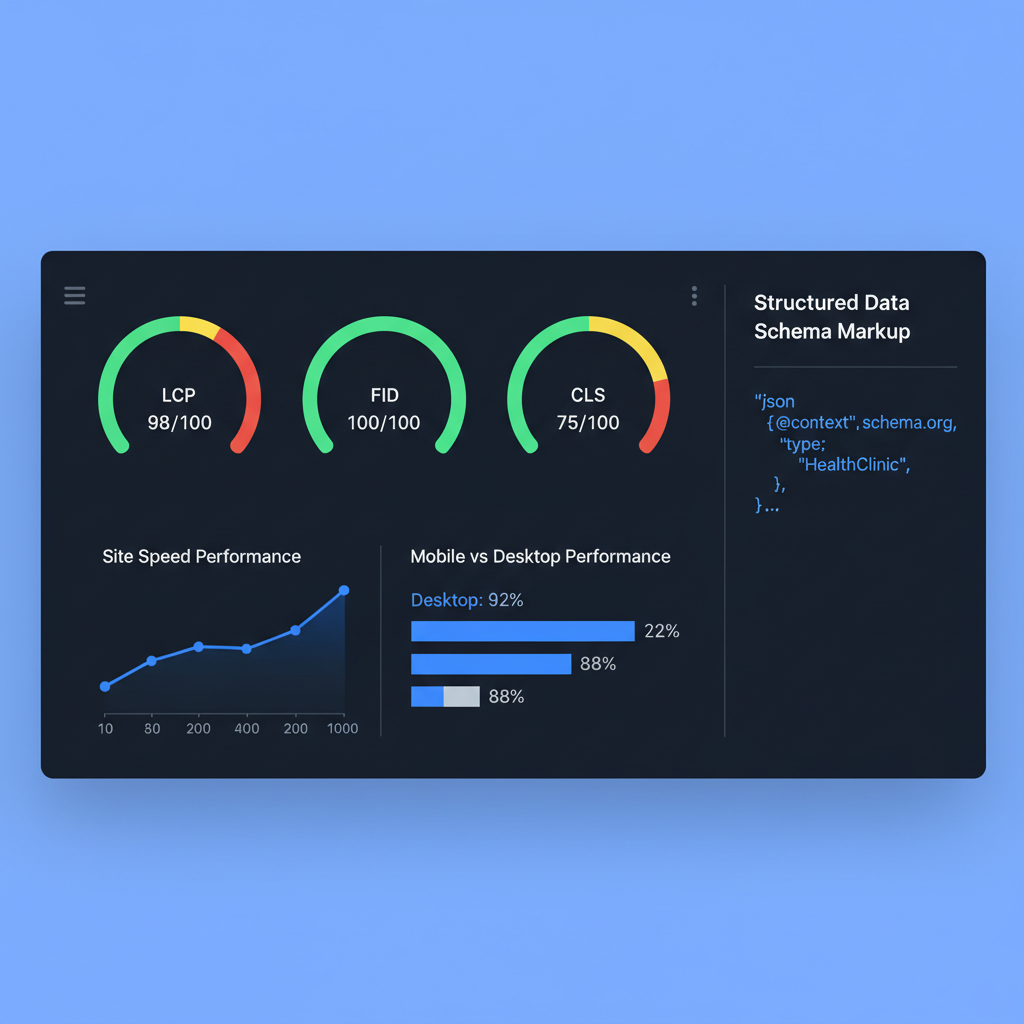
Core Web Vitals measure the real-world user experience of your website pages. Largest Contentful Paint (LCP) measures loading performance. First Input Delay (FID) measures interactivity. Cumulative Layout Shift (CLS) measures visual stability. Google uses these metrics as ranking signals — pages that deliver a poor user experience rank lower than technically equivalent pages with better performance scores.
Schema Markup: Making Your Practice Understandable to Google and AI
Schema markup is structured data code that tells search engines and AI systems exactly what your content means — not just what it says. For healthcare practices, the most important schema types are LocalBusiness, MedicalOrganization, Physician, MedicalClinic, FAQPage, and BreadcrumbList. Properly implemented schema markup enables rich results in Google search (star ratings, FAQ dropdowns, business hours) and improves entity recognition by AI systems like ChatGPT and Gemini.
Crawl Budget Optimization for Large Healthcare Websites
Crawl budget is the number of pages Google will crawl on your website within a given time period. For large healthcare websites with hundreds of service pages, location pages, and blog articles, crawl budget optimization ensures Google spends its crawl allocation on your most important pages — not on low-value URLs, duplicate content, or parameter-based URLs that add no ranking value.
A single technical issue — like a misconfigured robots.txt blocking key pages or missing canonical tags creating duplicate content — can suppress rankings across your entire website. Regular technical audits catch these issues before they compound into significant ranking losses.
Frequently Asked Questions
How often should a healthcare website undergo a technical SEO audit?
What is the most common technical SEO issue found on healthcare websites?
Does technical SEO affect AI search visibility as well as Google rankings?
Ready to Implement These Strategies?
Our healthcare marketing specialists handle everything — from technical SEO to content creation to review management. No long-term contracts.
Get a Free Consultation